

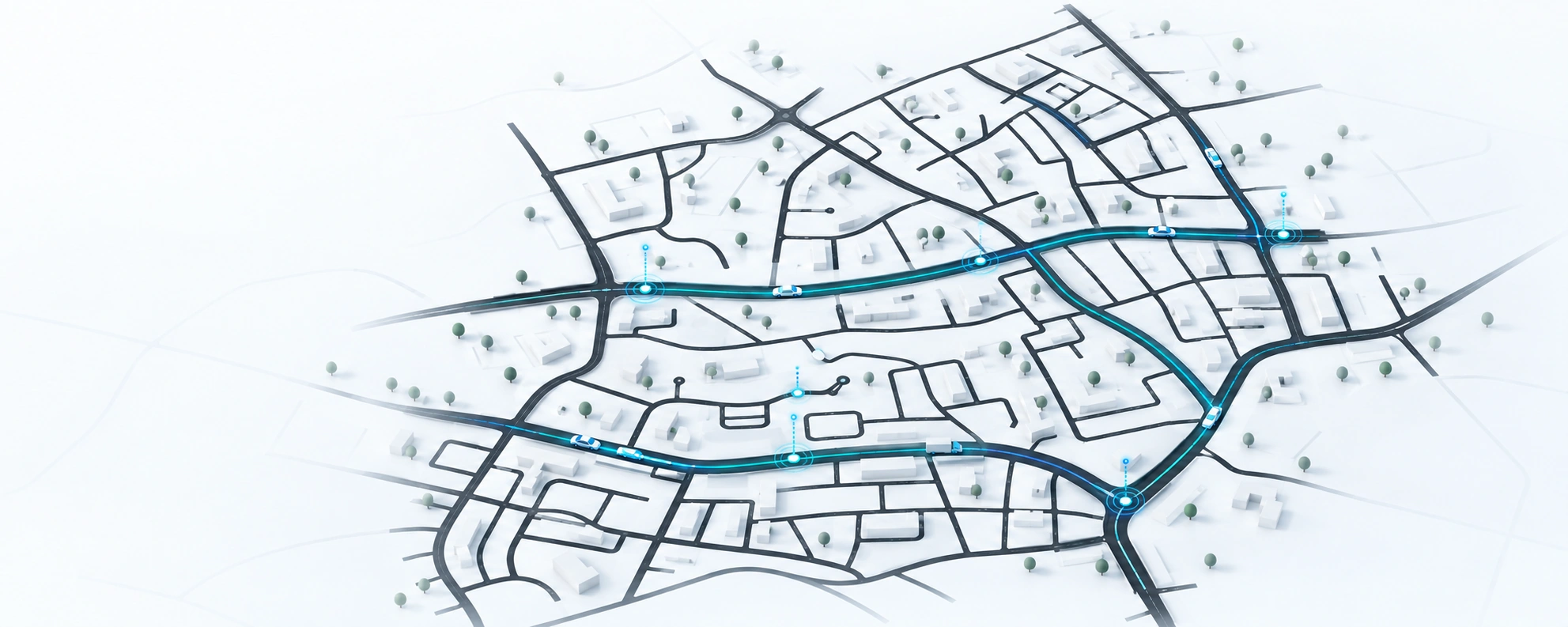
Real topology
Networks from Île-de-France and Ingolstadt varying in size and complexity.
 NeurIPS 2025
for RL-equipped Connected Autonomous Vehicles
A comprehensive benchmarking environment unifying evaluation across 29 real-world traffic networks to test multi-agent reinforcement-learning routing strategies in mixed-autonomy traffic.


Connected Autonomous Vehicles (CAVs) promise to reduce congestion by optimizing routing decisions collectively. However, standard benchmarks for this complex multi-agent problem have been missing.
URB fills this gap. It integrates the microscopic traffic simulator SUMO with RL-based solutions to create a realistic testing ground. It features 29 real-world networks, calibrated demand patterns, and a suite of baseline algorithms.
Networks from Île-de-France and Ingolstadt varying in size and complexity.
Calibrated trip patterns based on census and empirical traffic data.
Evaluate travel time, congestion, and network-level efficiency.
Fully reproducible datasets and modular configuration schemes.
URB standardizes the pipeline for setting up traffic scenarios, training MARL agents, and assessing their impact on the city.
29 real-world networks and demand patterns
URB dataset ↗MARL algorithms including IQL and QMIX
Compare travel times and congestion
URB metricsURB includes networks ranging from small towns such as St. Arnoult to dense urban centers such as Ingolstadt.
Small scale, 222 trips. Good for debugging and quick iteration.
Medium scale, 523 trips. Represents typical suburban traffic.
Large scale, 1,035 trips. High congestion and challenging coordination.


Powered by SUMO, URB simulates individual vehicle dynamics to provide realistic feedback to learning agents, going beyond fluid approximation models.
Car-following physics and gap acceptance
Traffic lights, right-of-way rules, and junctions
Interaction between human drivers and algorithmic CAV agents
We evaluated state-of-the-art MARL algorithms against URB baselines. The results reveal a significant challenge: current algorithms rarely outperform human drivers in complex, congested networks.
Results reported in URB (arXiv:2505.17734) ↗Mean CAV travel times. Lower is better. In small networks, QMIX occasionally beats humans.
In this scenario, RL agents achieved a win rate of 80% against URB baselines.
Algorithms that work on small maps fail to converge or improve upon baselines in larger networks.
Exploring suboptimal routes can cause regret and delays for commuters during the learning phase.
URB tracks progress toward methods that handle non-stationarity and massive scale.
Clone the repository, install the dependencies, and run a first experiment.
$ git clone https://github.com/COeXISTENCE-PROJECT/URB.git$ cd URB && pip install -r requirements.txt$ python scripts/qmix_torchrl.py --id demo --alg-conf config3 --task-conf config4 --net saint_arnoultImplement a solution using the provided template, run it like any other URB experiment, and submit the results for comparison.
Use the template script and documentation, then submit the resulting experiment through a pull request.
@inproceedings{URB,
  title={URB -- Urban Routing Benchmark for RL-equipped Connected Autonomous Vehicles},
  author={Akman, Ahmet Onur and Psarou, Anastasia and Hoffmann, Michał and Gorczyca, Łukasz and Kowalski, Łukasz and Gora, Paweł and Jamróz, Grzegorz and Kucharski, Rafał},
  booktitle={Proceedings of the Thirty-Ninth Annual Conference on Neural Information Processing Systems (NeurIPS 2025) Datasets and Benchmarks Track},
  month={December},
  year={2025}
}
Supported by


Benchmark results
URB benchmarks routing policies for mixed traffic with human drivers and connected autonomous vehicles (CAVs). The table below indexes experiment folders under results/ and ranks runs by benchmark metrics.
Research with URB
Questions about routing methods, tested with URB. Each study includes its proposal, experiments, conclusion, and any independent review.